
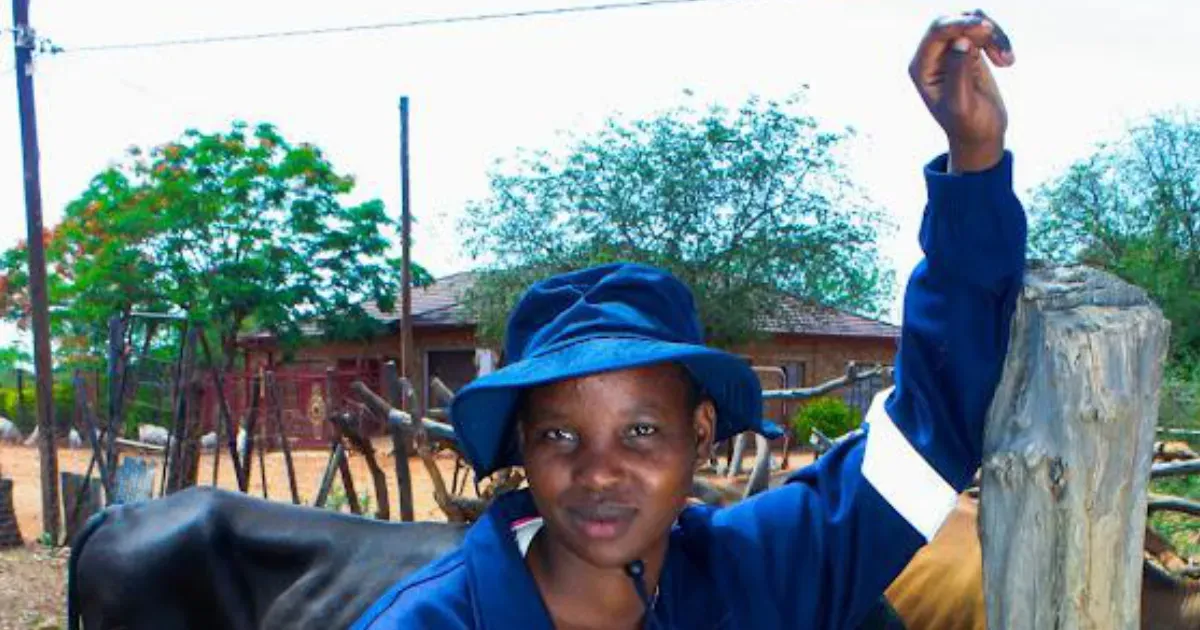
Through targeted training ecological restoration and Social Employment Fund support Avo Vision is empowering young women to lead sustainable livestock development in rural Limpopo.
Redefining Leadership in Rural Limpopo
In the quiet rural village of Ga-Kibi in Limpopo where livestock herding has long been upheld as a generational duty traditionally carried by men, Khomotso Mpeki is redefining what leadership and resilience look like in her community.
At 28 years old Khomotso has already become a symbol of determination for many young people in Ga-Kibi. Raised in a household surrounded by cows, sheep and goats, her journey as a herder began in childhood. “I grew up with animals so naturally I learned how to take care of them. It wasn’t something I planned but something I inherited,” she said. What started as a necessity has grown into a passion rooted deeply in family tradition and cultural preservation.
Preserving Generational Knowledge
For Khomotso herding is more than daily labour. It is a responsibility to her roots. Living with elders she recognises the urgent need for younger generations to embrace agricultural knowledge before it is lost. “Our elders won’t be here forever. If we don’t learn how to look after these animals now we will lose a generational gift,” she said. She believes that when young people commit to herding and farming they do not just sustain their families they sustain their identities.
Skills Development Through Training
Her work took a transformative turn when she received training from Avo Vision and Meat Naturally programmes aimed at improving rural livelihoods and livestock management. Before these trainings she had limited knowledge about livestock health. “I didn’t even know animals, especially cows, could have so many health problems. These training sessions opened my eyes. Now I can identify illnesses, manage grazing better and prevent problems before they start,” she explained.
Challenging Gender Norms
Being a female herder in a male dominated field has not been without challenges. “People didn’t believe a woman could herd. Sometimes when a cow had complications I would have to ask men for help. Not everyone took me seriously in the beginning,” she said.
Today discrimination has softened and her community has begun to embrace her role with greater respect. “It’s not as bad as when I started. Seeing young girls and even boys wanting to learn about farming makes me happy. It means things are shifting,” she said.
Restoring Land and Strengthening Herds
Khomotso’s responsibilities extend beyond simply watching over livestock. She plays an active role in land restoration and sustainable grazing practices skills taught through Avo Vision’s ecological training.
Her tasks include brushing and packing biomass from cut trees, pounding by digging holes perpendicular to water flow to retain moisture, creating water access points for livestock and ensuring grazing areas regenerate.
“We do this work so that the land can breathe again and our animals can graze without running out of food,” she said.
Financially the farmers in Ga-Kibi pool their resources to buy supplementary feed when necessary. “We save together so that when the land is overgrazed we can still provide for the animals but Avo Vision helps us a lot so we don’t struggle as much,” she said.
Empowering Youth in an Unemployment Stricken Community
Ga-Kibi faces high unemployment making agriculture one of the few sustainable livelihood options for many young people. “It makes me happy to see young people wanting to herd or farm. At least they can have some income for themselves,” she said.
Her message to young women is clear. “Learn how to take care of your family’s livestock. If you can herd your own animals you don’t need to pay someone else. That money can go to other important things,” she said.
Building a Future Through SEF
Khomotso is a participant in the Social Employment Fund SEF initiative which provides financial aid to support community driven work. “I continue this work to help my community and to support my siblings so they can go to school,” she said.
Her long term vision remains strong. “I want to save money to buy more livestock especially goats so I can grow and become an established female herder in my community,” she said.
Her journey is a powerful reminder that with the right support training and opportunity young women in agriculture can lead the way preserving heritage restoring the environment and strengthening rural economies.